
Google books Blue Origin New Glenn for Project Suncatcher orbital compute launch in 2029
Google signed a launch agreement with Blue Origin for Project Suncatcher on New Glenn in early 2029, reserving capacity to put rack scale AI satellites into sun synchronous orbit.
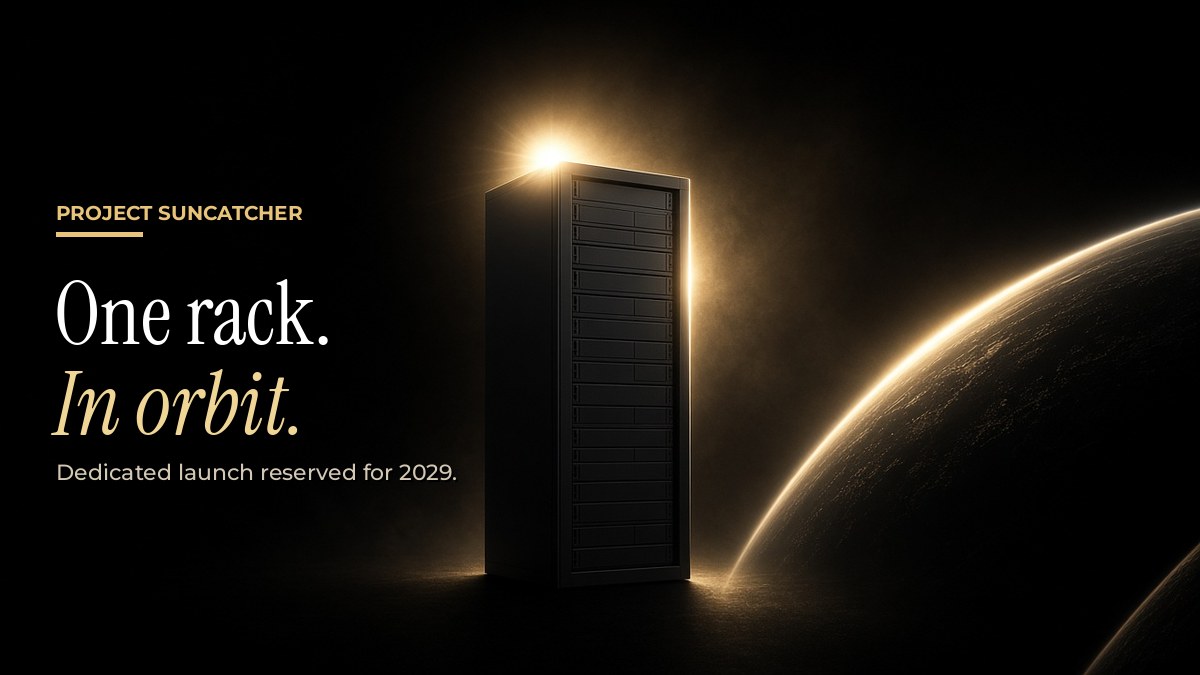
On November 19, 2026, Google and Blue Origin announced a launch services agreement for Project Suncatcher, Google's long term research program on running artificial intelligence hardware in orbit. Under the agreement, Blue Origin will fly Google satellites on its heavy lift New Glenn rocket, with the mission targeted for the first quarter of 2029.
This will be Google's first dedicated heavy lift launch booked specifically for Project Suncatcher. Neither company disclosed how many satellites will fly on the mission or the value of the launch contract.
What the 2029 mission is designed to test
Project Suncatcher explores whether solar powered satellites carrying Google Tensor Processing Units, known as TPUs, can perform machine learning workloads in space. In terrestrial facilities, TPUs are the custom chips Google uses to train and serve AI models.
According to Travis Beals, senior director of Project Suncatcher at Google, each satellite on the 2029 New Glenn flight is designed to carry computing capacity roughly equal to one data center rack. A rack is the standard cabinet that holds servers, networking gear and power distribution inside a data center on the ground.
Blue Origin will place the satellites into a sun synchronous orbit. In a sun synchronous orbit, a spacecraft passes over any given point on Earth at roughly the same local solar time each day and can stay in continuous or near continuous sunlight. That exposure gives solar arrays steady power without the day and night interruption that limits ground solar plants.
Jordan Charles, senior vice president of New Glenn at Blue Origin, said the rocket's heavy lift capacity and large payload fairing give customers room to deploy new orbital hardware architectures. For Google, booking a dedicated heavy lift mission moves Project Suncatcher beyond single piggyback test payloads into larger spacecraft sized for rack level compute.
From the October prototype to twin satellites in 2027
Google introduced Project Suncatcher in 2025 and moved quickly to hardware trials in 2026. On October 1, 2026, Google launched a prototype satellite built with Planet Labs aboard a SpaceX Transporter 18 rideshare mission. That spacecraft carried four TPUs into low Earth orbit to test whether data center chips could survive launch vibration, thermal swings and space radiation.
After four weeks of commissioning the spacecraft bus and TPU trays, Google reported its first AI output from orbit on October 30, 2026. During a ground station pass near Svalbard, Norway, engineers uplinked a prompt to an onboard instance of Google's Gemma 4 open model and received a short generated reply, followed by additional text and payload telemetry prompts.
Google stated that the October satellite is now running longer tests on thermal stress and radiation effects. Those measurements matter because silicon designed for air cooled or liquid cooled data centers on Earth behaves differently when exposed to ionizing radiation and vacuum heat rejection.
Before the 2029 New Glenn launch, Google plans an intermediate milestone in 2027. That mission will place two interconnected satellites into orbit to test whether multiple spacecraft can coordinate distributed AI computations across an inter satellite link.
Why orbital compute is getting serious attention
Google is not the only technology company testing compute in orbit. SpaceX and startups such as Starcloud have also outlined plans to deploy orbital data centers in low Earth orbit. The shared motivation is straightforward: electricity generation and grid connection queues are becoming tight bottlenecks for large ground AI clusters, while sunlight in certain orbits is abundant.
At the same time, major technical questions remain unanswered in public disclosures. Neither Google nor Blue Origin has published numbers on total payload mass, radiator area needed to dump waste heat in vacuum, expected chip failure rates over multi year orbital lifetimes, or the bandwidth and latency of optical or radio links back to terrestrial fiber networks.
A single rack of servers on the ground consumes tens of kilowatts of power and sits inside a building with redundant fiber routes and technicians on site. In orbit, every kilowatt requires solar panel area, thermal radiators and radiation shielding, all of which add mass that must be paid for per kilogram on a rocket.
My take
I would not change a single terrestrial data center plan based on a 2029 launch reservation at the scale of one rack per satellite. Commercial AI clusters today measure capacity in tens of megawatts and thousands of racks, not single cabinets in orbit.
What makes this agreement worth watching is the sequence of engineering gates Google is setting up. First came four TPUs in October 2026 to prove basic survival and inference. Next comes the 2027 pair of satellites to prove two nodes can talk and share work. Then comes the 2029 New Glenn flight to test rack scale hardware.
As an operator, I will look at three metrics over the next three years rather than launch announcements. First, how long the October 2026 TPUs run without unrecoverable radiation faults. Second, how much power and cooling mass a single orbital rack actually needs once deployed. Third, how data and results move between orbit and ground telecom networks without becoming the bottleneck.
If orbital compute finds early commercial value, it will likely start with workloads that originate in space, such as processing Earth observation imagery before transmission, rather than serving interactive user traffic from the ground.
Primary sources
- Google partners with Blue Origin on Project Suncatcher heavy-lift launch (Google)
- Google Selects Blue Origin's New Glenn for Project Suncatcher (Blue Origin)
- Google Orders Heavy-Lift Launch for Project Suncatcher from Blue Origin (Via Satellite)
- New Glenn to launch Project Suncatcher data center satellites for Google (SpaceNews)
- Google receives response from Project Suncatcher prototype satellite in space (Google)